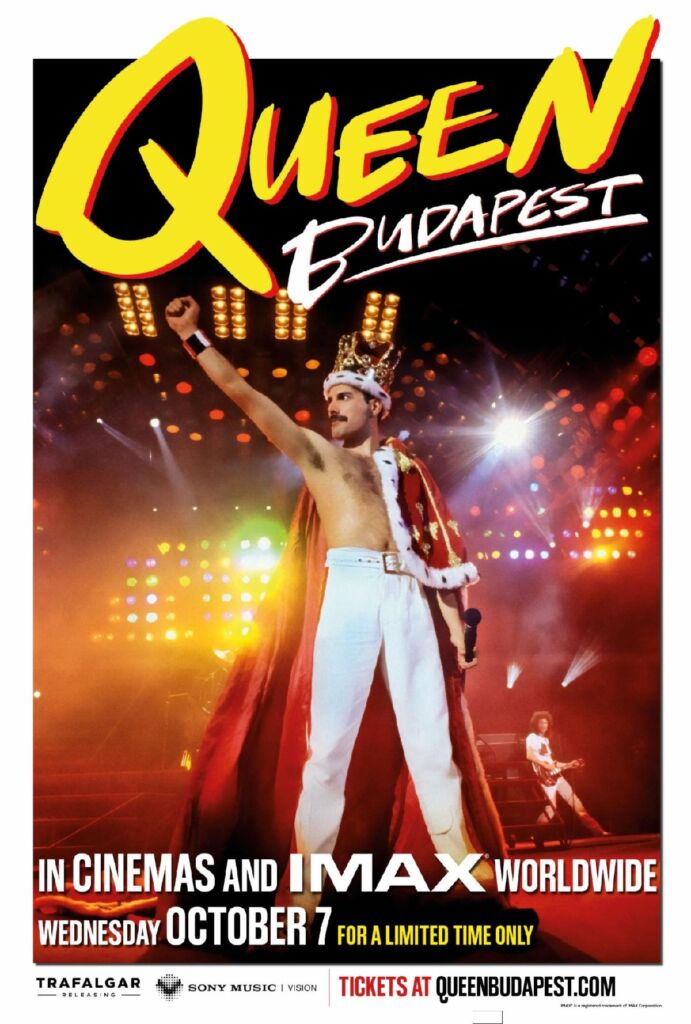

Queen fans will get the chance to revisit one of the band’s most historic performances when Queen Budapest arrives in cinemas and IMAX worldwide on October 7 through Trafalgar Releasing.
The release celebrates 40 years since Queen performed at Budapest’s Népstadion on July 27, 1986, during The Magic Tour. The concert marked the first time a Western stadium rock band played behind the Iron Curtain, making it one of the defining live events of the decade.
The film has been restored in 4K from the original 35mm negatives by Sir Peter Jackson’s Park Road Post Production facility in New Zealand. The audio has also been remixed from the original multitrack recordings, giving the performance its best presentation to date.
Around 80,000 fans packed the stadium for the show, while another estimated 45,000 gathered outside to listen. Concertgoers also traveled from countries including Russia and Poland to witness the event. The production itself was a major undertaking, with 17 Hungarian cameramen using 17 cameras and roughly 25 miles of film—reportedly all the film stock available in the country at the time. Approval from the Hungarian government made the filming another first for a Communist state.
Looking back, the Budapest performance gained even greater significance. Queen played only five more concerts after that night, wrapping up their touring career with Freddie Mercury at Knebworth Park in England on August 9, 1986.
As the final professionally filmed live performance featuring Freddie Mercury, Queen Budapest captures the band in peak form. The setlist includes classics such as “We Will Rock You,” “We Are The Champions,” “A Kind Of Magic,” “Crazy Little Thing Called Love,” “Under Pressure,” “Who Wants To Live Forever,” “Hammer To Fall” and “Bohemian Rhapsody.” The concert also features a performance of the Hungarian folk song “Tavaszi Szél Vizet Áraszt,” while newly restored footage from “Radio Ga Ga” highlights the work completed for this release.
The concert continued reaching audiences after the tour ended. An edited version aired throughout the Communist Bloc in December 1986, including broadcasts in China, Poland, Czechoslovakia, East Germany, Yugoslavia and Mongolia. It was also screened in 59 Hungarian cinemas on New Year’s Day 1987, another milestone for a Western rock act.
For guitarist Brian May and drummer Roger Taylor, the Budapest show remains one of the band’s most meaningful performances.
Brian May comments: “For years, fans behind the Iron Curtain had been able to listen to Queen music only on illegal cassettes. It was a forbidden thing to listen to rock bands like us, so to see them play in a live show would have been unthinkable. This concert, when they could finally come and see us live in person and interact with us, was a huge emotional moment for them and also for us. It felt like a very big deal — you could feel that incredible energy. There will never be an event quite like that again. Perhaps the most memorable highlight of all was performing that beautiful Hungarian folk song, which Freddie and I had learned for the occasion. Not a dry eye!”
Roger Taylor adds: “We did love to think that the music could transcend the politics, the political barriers, and that was sort of part of our ethos, to actually bring the audience into the show and make them feel part of the show. I know Freddie tried to learn this folk song, but he had the words written phonetically on the back of his hand. When the audience just started singing, we realized, wow, music really can be a great cause.”
Discussing the restoration, Brian May continues: “Peter Jackson‘s team has done a magnificent job of restoring the original film footage, at the highest resolution ever; it’s pristine and the quality is breathtaking. I think you’re going to love it. For the sound, we’ve been able to do some top-quality restoration work as well. Now, in IMAX and movie theatres, it’s going to be definitively the most real experience ever of us, Queen, in our glory days. I think people will get lost in it and even forget they’re watching a film.”
Tom Mackay, president of Sony Music Vision, said: “Queen Budapest represents a remarkable moment in both music and cultural history. The film not only documents an extraordinary performance, but also the connection between the band and an audience breaking through real barriers at the time. The restoration allows that moment to be experienced in a way that feels immediate and relevant for audiences today.”
Peter Jackson adds: “As long time fans of Queen we were thrilled when they asked Park Road Post to restore the Budapest concert footage. It has been a rare privilege to breathe new life into such an iconic moment in music history. We look forward to a whole new audience participating in the original band’s final live performance, captured on film. They will rock you!!!”
The restored film will make its world premiere at the Budapest Classics Film Marathon on September 15 before a U.K. premiere in London on September 30. The original negatives were digitized by Hungary’s National Film Institute FilmLab, while the film elements have been preserved by the NFI Film Archive since 1986.
Queen Budapest opens in cinemas and IMAX worldwide on October 7 for a limited engagement. A companion release follows on October 30 through Hollywood Records in North America and Legacy Recordings internationally. Alongside Blu-ray, DVD, CD and digital editions, the newly remixed soundtrack will also receive its first-ever release as a three-LP vinyl set.
Directed by János Zsombolyai, Queen Budapest serves as both a document of one of rock’s most important concerts and the final filmed record of Freddie Mercury leading Queen onstage.
More than five decades into their career, Queen remains one of rock’s biggest names. With worldwide album sales exceeding 300 million, enduring tracks including “Killer Queen,” “We Are The Champions,” “We Will Rock You,” “Another One Bites The Dust” and “Bohemian Rhapsody,” plus Greatest Hits standing as the U.K.’s best-selling album of all time, the band’s legacy continues to grow.
Their influence extends well beyond record sales. Landmark performances such as Live Aid and Wembley Stadium in 1986 helped define Queen as one of rock’s greatest live acts, while the 2018 film “Bohemian Rhapsody” introduced their story to another generation. Their music continues to inspire artists ranging from George Michael and Guns N’ Roses to Lady Gaga and the Foo Fighters.
Recognition from the Rock And Roll Hall Of Fame, the Brit Awards, the Grammy Awards and the Ivor Novello Awards reflects the band’s impact, but the lasting connection between Queen and their audience remains their strongest achievement. Thanks to Brian May and Roger Taylor, that legacy continues to reach new generations of rock and metal fans.