

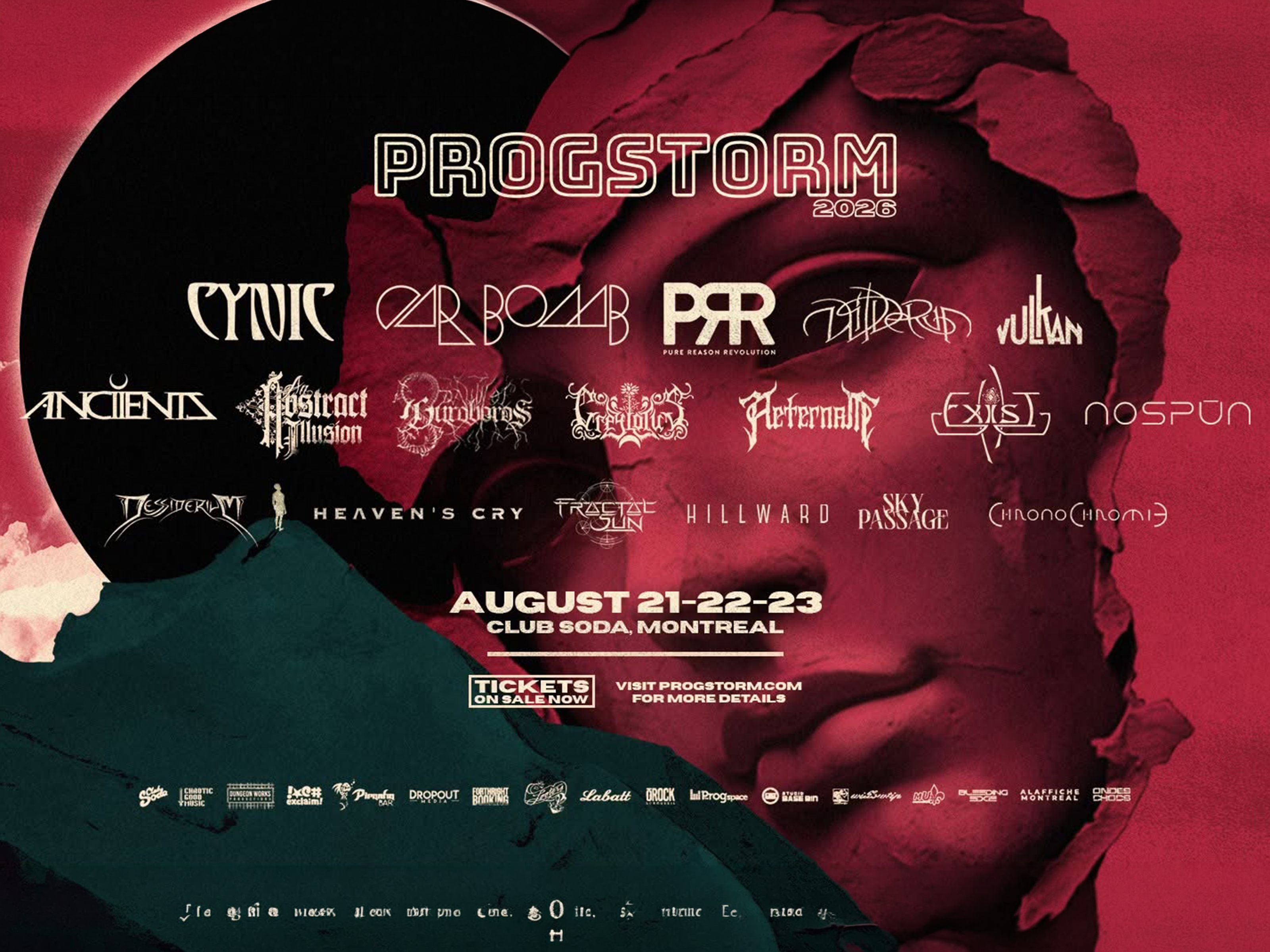
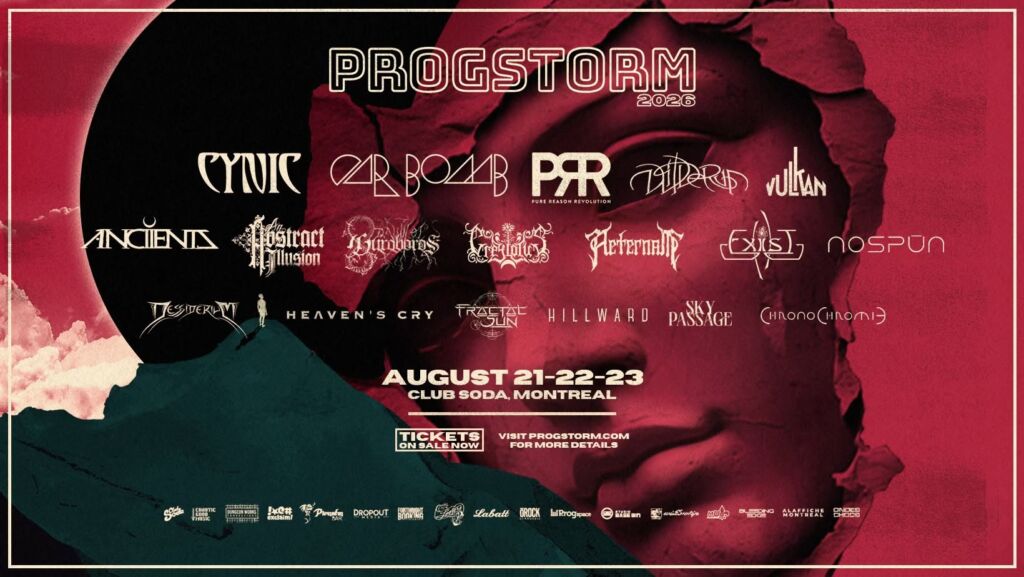
Canada didn’t have a festival built entirely around progressive metal until Jici and Ed decided that was a problem worth solving themselves. ProgStorm launched in Montreal as the country’s first festival dedicated exclusively to the genre, and its second edition arrives considerably bolder than its first: Cynic, Car Bomb, and Pure Reason Revolution headline a lineup that also carves out real space for the genre’s next wave, acts like Nospūn, Fractal Sun, and An Abstract Illusion. Car Bomb returns to Montreal after 15 years away. Pure Reason Revolution makes its first North American appearance in two decades. Bands are crossing oceans to play a festival that didn’t exist three years ago, and fans are crossing them right back just to be there.
We caught up with co-founders Jici and Ed to talk about what the first edition taught them, how they’ve built a lineup that spans everything from technical extremity to atmospheric restraint, the logistics of coordinating international bookings for a niche audience, and why they think prog metal fans, wherever they’re from, tend to find each other and feel a little less alone once they do.
Secure your tickets for ProgStorm 2026 here.
ProgStorm has grown significantly between its first and second editions. What lessons did you learn from the inaugural festival that directly influenced your plans for 2026?
Jici: The first edition definitely gave us the confidence that we were able to grow into something bolder, like securing an iconic venue such as Club Soda and reaching out to top-class bands like Cynic, Car Bomb, and Pure Reason Revolution, just to name a few. We also realized during that first edition that our intuition was right and that there was definitely a scene for this kind of niche prog metal festival, not only in Montréal, but also among so many dedicated prog fans from all over the world who are ready to get on a plane just for this. And contacts, that’s the big one that makes all the difference.
Ed: The first edition was a huge milestone that really brought us together as a solid team and gave us a strong framework for how we do things. Everything was brand new back then, which came with its share of unique challenges and surprises. But we lived through it, learned from it, and this time around, we actually planned for it! As Jici said, building contacts is a major factor, but I also think many bands and fans have heard of us now and know how well we host. For a niche community like prog metal, word of mouth goes a very long way.
Montreal has a rich metal history, but progressive metal has traditionally been underserved by dedicated festivals. What convinced you that the time was right to launch Canada’s first festival devoted entirely to progressive metal?
Jici: The story is that my bandmates in Voidchaser and I had just been invited to ProgPower Europe, and we were so excited about it. At some point, we started talking about why we didn’t have our own prog metal-specific festival in Montréal, or even in Canada. That’s when I decided we should just do it ourselves. The next day, we had a meeting with The ProgSpace, and soon after I called my friend Eddy because I had a feeling this was something he would love to be part of. I think I was right!
Ed: I think we both grew up feeling envious of all the amazing festivals and tours that happen largely outside of North America, and I think we’ve always had that question: Why not here? Montreal has a rich metal history, as you say, and more than a handful of bands here have been pushing the music genre for decades now. So why not here? I had that same question after playing at ProgPower Europe with The Anchoret the year before I returned with Voidchaser, but I somehow accepted that it was the natural order of things. Until I received Jici’s call asking me: Why not? I don’t think I needed that much convincing at that point, haha!
This year’s lineup balances legendary names like Cynic, Car Bomb and Pure Reason Revolution with newer acts such as Nospūn, Fractal Sun and An Abstract Illusion. How do you approach building a lineup that appeals to longtime prog fans while also introducing them to the genre’s next generation?
Jici: Having our own progressive metal bands, Voidchaser and The Anchoret, and being inspired by the many bands in the genre makes us very aware of the community, what bands have great momentum, which ones are the next big things, and which ones have already made a big impact on this music. I’d say it’s both a logical process and a very intuitive one. It’s difficult to qualify, but we’re constantly talking about potential additions to future lineups.
Ed: I think we somewhat act as each other’s soundboards, throwing out ideas and seeing what sticks, what makes sense. I think we are fans first, and being part of the community, we understand and appreciate the music and the bands. And, we love discovering new acts that blow our collective minds. Because of this, one of the festival’s mission statements is to give a platform and showcase lesser-known bands that we truly believe deserve to be seen and heard and supported!
Was there one particular band you considered your biggest “get” this year, either because of scheduling challenges or because you’ve wanted them since the festival was first conceived?
Jici: Wilderun, Anciients, and Nospūn were some of the first bands we thought about when we first started planning ProgStorm. We reached out to them for the first edition, but it didn’t work out at the time. So we’re very happy to finally have them for the 2026 edition! We’re very proud of all the bands on the lineup, but of course being responsible for bringing Car Bomb back to Montréal after 15 years, Pure Reason Revolution back to North America after 20 years, and presenting the North American premieres of bands like An Abstract Illusion and Vulkan is incredibly special. On top of that, allowing these bands to share the stage with a legendary band like Cynic… all of this is a very special feeling.
Ed: Oh, there are definitely a few pie-in-the-sky bands we are proud to present this year…but I don’t think I can choose a favourite. As Jici puts it, all of this is truly a very special feeling.
Many of this year’s performances are rare North American appearances or long-awaited returns. How difficult is it to coordinate these bookings, especially for bands with limited touring schedules?
Jici: Inviting bands from another continent, like An Abstract Illusion, Pure Reason Revolution, Vulkan, or Fractal Sun, is definitely a challenge, but not an impossible one. Some of them are coming for a simple fly-in, fly-out, while for others we’re helping produce a couple of Canadian shows after the festival.
Ed: I think that because this is our second edition of the festival, we have a lot more experience with managing time zones and coordinating touring schedules this time around.
Progressive metal has become remarkably diverse, encompassing everything from classic prog to djent, technical death metal and post-metal. How important is stylistic diversity when curating ProgStorm?
Jici: It is very important, actually. Of course, the identity of ProgStorm Festival is that it’s a festival dedicated to progressive metal. But the way we see it, the genre is not monolithic. There are many subgenres, and there’s a continuum between the extreme and the more melodic, or between the technical and the emotional. We try to bring together fans of all these different styles under one roof.
Ed: What exactly is Prog, anyway? It’s the eternal debate amongst fans and musicians alike. I think we enjoy heavy, dramatic, complicated, avant-garde, and button-pushing music as a whole and that seeps into the Progstorm identity of “progressive metal,” which is, if you think about it, a very umbrella term for such diverse music.
What has surprised you the most about the response from fans outside Canada? Have you seen attendance from countries or regions that exceeded your expectations?
Jici: Especially during the first few months of ticket sales, it’s mostly people from outside Canada who buy their tickets because they’re planning a trip around the festival. It’s something that amazes us every single time, seeing hundreds of people crossing oceans and traveling hundreds or even thousands of kilometers to come to our festival. We’ll never take that for granted.
Ed: The response has been absolutely incredible. Seeing this humble new festival grow into a major destination for so many people is a beautiful shock we are still trying to process. As I’ve mentioned, growing up, I was always envious of the amazing festivals and tours across Europe. Now, seeing so many European attendees flying directly to Montreal just for ProgStorm is truly surreal. In a way, ProgStorm has become both a destination and a bridge—bringing people together from all corners of the globe and making the world feel just a little bit smaller.
Independent festivals face enormous logistical and financial challenges. What has been the biggest obstacle in turning ProgStorm from an idea into a sustainable annual event?
Jici: Like any business, the first few years are much riskier. But Eddy and I have had many conversations about our risk tolerance because we deeply believe in this project, both in the short and long term. We’re learning a lot by observing more experienced promoters, and we do our best to put ourselves in the best possible position to face those challenges. We want to do this for at least as long as our friends at ProgPower Europe and ProgPower USA, who have recently celebrated, or are about to celebrate, their 25th anniversary.
Ed: Risk tolerance and resource management are a big one, for sure. It is important for us to keep the festival true to our vision and stay independent. The first edition acted as a proof of concept, but this still is a very niche festival, and so I think a big challenge is finding sponsorship.
How involved are the artists themselves in shaping the festival experience? Do bands ever recommend other acts or influence future booking decisions?
Jici: We have a lot of bands recommending other bands to us, or encouraging them to apply for ProgStorm, and we’re always open to that. The friends of our friends are our friends, so it always helps us make contact or know that we probably share similar values with a band if they’ve been recommended by a band we already trust.
Ed: All in all, the prog metal community is a very small, tightly-knit one where word of mouth goes a long way. As cliché as this sounds, ProgStorm really is the friends you make along the way – the relationships you develop shape us as human beings and have more than a hand in shaping the festival.
If someone has never attended ProgStorm before, what do you think they’ll discover here that they wouldn’t experience at a larger, more mainstream metal festival?
Jici: The French-Canadian hospitality! I think part of the stereotype about us is true, and it shows in the way we treat every artist and every person attending the festival. We do our best to make everyone feel welcome and important. Also, the prog metal community is an incredibly passionate one. When a prog metal fan meets another prog metal fan, it’s like you feel a little less alone for a second, and you instantly know you share the same love for weird music (and I mean that as a compliment).
Ed: The vibrant city of Montreal has a welcoming character, but the sense of community and passion ProgStorm has for its city, the people, and the music is really hard to put into words. Expect to be welcomed, to have a great time, discover your new favourite band, eat poutine and make new friends!
The progressive metal scene has become increasingly fragmented into subgenres. Do you see ProgStorm as a festival that celebrates that diversity, or are you trying to define a broader identity for modern progressive music?
Jici: We leave room for the different subgenres within progressive metal, and that creates space for extreme bands like Dawn of Ouroboros, Car Bomb, and Greylotus, as well as more atmospheric and contemplative bands like Pure Reason Revolution or Hillward, for example.
Ed: We’re all for diversity and discovery! Progressive music is hard to pin down to a single style, and I think that this is what really makes us love it even more! The important thing with ProgStorm is to present the best possible context for all the different bands to shine and complement each other.
Five years from now, what would success look like for ProgStorm? Are you hoping to remain an intimate destination festival, or do you envision expanding into one of North America’s premier progressive music events?
Jici: With time, I simply hope that people from Montréal and beyond will continue coming together at ProgStorm Festival for a full weekend celebrating the music we all love. I hope people will come to see Montréal as an important destination for progressive metal, where they’ll be used to seeing both their favorite artists at ProgStorm and rare gems making their Canadian or North American debut. That’s my vision.
Ed: Exactly! Being a destination, a meeting point for this beautiful community of music lovers is the only metric of success I truly, deeply care about. The sense of community, more specifically of giving back to the community that has been so kind to us and our bands and projects, is really at the crux of why we do what we do.
Are there any dream headliners or reunion performances that remain at the top of your wishlist?
Jici: Yes, and I’m not going to tell you who they are, but stay tuned, because we already have some of them planned for the 2027 edition!
Ed: Haha! 2027 and beyond! But yes, let’s keep the surprises – it is half the fun after all!
How do you balance commercial realities with artistic ambition when booking a festival aimed at such a passionate—but relatively niche—audience?
Jici: We have a very clear vision for ProgStorm, and because we have that vision, we find solutions around it. Passion comes first, then business and finances find a way.
Ed: It’s not as much of a tightrope as it seems, more like two different buckets altogether. First comes passion, as Jici puts it – always! The rest follows organically, and keeping our goals in mind and close to the heart, decision-making becomes that much easier.
If you could change one misconception people have about progressive metal today, what would it be?
Jici: Some people think prog is just musical masturbation. They have a hard time with odd time signatures, microtonal music, or complex techniques. For me, music and art in general don’t have to be pretty; they can also be disruptive and uncomfortable. Prog metal is a form of art that allows for so many emotions because it pushes the limits of what’s musically possible. That’s something I love about the genre: being moved, surprised, or even disturbed… reacting to music I never could have imagined.
Ed: I’ll ask again, what exactly is prog? I think Prog is all about the musical journey. It’s a long-form type of media format that exists despite social media increasingly pushing for smaller and shorter, one-and-done formats. Prog is not only about pushing the limits of technical ability, but about saying something new and leaving the world a better place for it.