



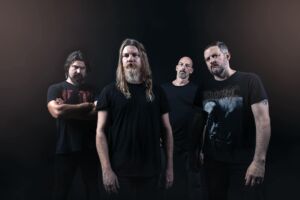





In a rare and intimate moment between soundcheck and a show in Spain, Mike Portnoy sat down with El Estepario Siberiano, who called him “the man that I consider to be my father.” The conversation was full of warmth, honesty, and reflections on a decades-long career behind one of the most influential drum kits in progressive music.
Asked when he started drumming, Portnoy immediately took it back to a turning point: “I think I was always tapping on things and had this hyper energy… I was a big music fan. I loved music from when I was a baby. And then my 11th birthday was when I got my first drum set. And it was kind of crazy because it was a gift from my grandfather. He gave it to me for my 11th birthday, and he had a heart attack that day and passed away a few days later. So it was almost like his final gift to me and, you know, kind of passed on his lifeblood to me through a drum set.”
That first set—a small four-piece Royce—sparked something big. But it wasn’t until Portnoy bought his own Tama Imperial Star kit with money from three summer jobs that the long road to Images and Words really began: “I used that on the first two Dream Theater albums and tours. I still have that one back at home.”
Before there were tutorial videos, Instagram clips, or notation books, Portnoy learned through feel and obsession: “I would practice hours and hours and hours every day. I mean, this is back in the ’70s… we didn’t have videos on YouTube and things that you could see. So you would just have to listen to records with headphones and learn that way.”
“Back then, I was listening to The Beatles and Ringo Starr, Led Zeppelin and John Bonham, The Who and Keith Moon, Kiss and Peter Criss. I would just sit in my room with headphones and play along to my records.”
Later, at Berklee, his focus wasn’t drumming but theory and composition. Still, the learning continued through sheer repetition: “We would practice six hours a night, five nights a week. Even after we left Berklee and went back home, all those years writing Images and Words and those first couple albums, we were practicing six hours a night, five nights a week.”
For someone known for playing some of the most rhythmically complex material in rock, Portnoy is strikingly uninterested in technical showmanship for its own sake: “Honestly, me as a drummer… to me, I think it’s more about playing the song than playing the drums.”
“When I’m playing drums, I’m thinking more about the song. I have to play the song more importantly than playing the drums. And when writing music like with Dream Theater, I’ll be behind the drums and that’s my tool to express myself… but still, I’m thinking about the guitar part, the keyboard part, the composition, the melody, the instrumentation, sometimes the lyrics,” he explained.
“To me, it has to have groove. Everything I do has to feel good. I’m very conscious of what’s happening while I’m writing it. I know the numbers, I know the time signatures and the rhythms and the patterns… but at the end of the day, I want whatever I play to feel good and feel natural.”
Even songs full of shifting meters and rhythmic illusions eventually need to flow without mental gymnastics.
“When we’re writing it, I don’t think you can write crazy shit like ‘The Dark Eternal Night’ or ‘The Dance of Eternity’ unless you know what the numbers are doing. You have to understand it. But if I had to think like that live on stage, my head would explode. So, by the time you record it, it should be comfortable… and by the time we get onto the stage and we’re performing these things live, I don’t think about it anymore. I need to just kind of just feel it and play and be in the moment and in the vibe and the groove.”
That mindset extends to arranging odd-time parts — breaking down bars of 12 into patterns of 3, 4, or 6, not for the sake of flash, but to serve the feel: “You have to do what’s called for. Just because you can do something doesn’t mean you always should.”
Portnoy didn’t hesitate to name Lars Ulrich among his personal influences, even knowing the backlash that invites: “A lot of people give him a hard time over his technique and everything. But to me, he was an influence because it was more than just drums. He was the leader of the band. He would write the set list. He would deal with the fan clubs and the merchandise. He was co-producing the albums and co-writing the music. He, to me, was a role model. And even to this day, he still is.”
“I went and saw Metallica a few weeks ago, and more than just the drumming, his personality and his presence, he was so important for Metallica‘s success that, to me, that was the thing,” he added.
Portnoy has won 32 Modern Drummer awards – but he’s deeply ambivalent about what they represent.
“If anything, I feel embarrassed by them. I always say this, but it’s the truth: music and drumming are not a contest. It’s not something that should be like an Olympic sport where you get the gold award, you get the silver award… There are thousands of drummers out there who can play circles around me. You could do it with one hand what I do with four limbs.”
He keeps it simple: “If you’re picking up a pair of drumsticks and you’re able to make something musical out of it and your heart is into it, then you should win that award.”
Portnoy’s success with Dream Theater wasn’t immediate. He emphasizes the years of hard work that led to Images and Words breaking through in 1992: “Those seven years were spent just practicing and writing and practicing and writing… and frustration. Things that maybe could have happened but never happened. Opportunities that ended up not happening. Just time after time, things were knocking us down. And we just kept getting back up and persevering. We never gave up. We believed in ourselves.”
Looking back, he still doesn’t think he “made it” in the conventional sense. What he feels is gratitude: “There were little benchmarks… but it’s important to note it didn’t happen overnight. The gratitude is what remains.”


1 Comment
Thanks so much for this interview.
Thanks Mike for your music. I really appreciate your statement ” Drumming and music isn’t a competition ” that really resonates with me. I play music and have been playing drums since I was 5.
I am inspired by many drummers. You are on top of that list. I appreciate and respect what you have done and continue to do.
Best to you always.
Michael